Introduction
Luxury residences in the Middle East and Africa are facing an unprecedented convergence of demands: extreme climates, escalating electrification (especially for cooling and electric vehicles), and rising expectations for energy independence and resilience. Against this backdrop, three-phase electrical infrastructure emerges not as a niche upgrade, but as a strategic necessity for modern high-end homes. A three-phase supply can dramatically expand a home’s electrical capacity, balance heavy loads, and seamlessly integrate advanced energy systems like solar PV arrays, large batteries, bidirectional EV charging, and even private microgrids. In an era of skyrocketing comfort and connectivity needs, three-phase power is a future-proof asset that enhances property value, performance, and reliability. This white paper details the compelling technical and economic case for treating three-phase power as the standard for luxury homes, with a special lens on the market realities of the Middle East and Africa.
The Future-Proof Investment: Asset Value & Compatibility
Installing a three-phase supply from the outset transforms a residence’s capabilities and market appeal. For high-net-worth homeowners and developers, this translates to measurable asset value and market differentiation. In emerging markets, new electrical infrastructure is already a key property driver; in Kenya, communities for high-end homes have seen land values jump 12–34% within two years of new power substations coming online. In other words, buyers recognize that robust power availability—which in practice means ample three-phase capacity—is tantamount to growth potential and reliability. Indeed, modern luxury buyers increasingly expect “future-ready” houses that can support the latest appliances, home automation, and energy systems.
A three-phase system signals precisely that readiness. It provides far greater power density and flexibility at the breaker panel: for the same wire size, a three-phase feeder can deliver roughly the square root of three (approximately 1.732) times more power than a single-phase one. For example, two 50-amp conductors on a single-phase 240-volt circuit deliver about 12 kW, whereas using the same #6 AWG wiring in a 208-volt three-phase Y connection (50 amps per phase) yields approximately 18 kW—a 50% increase. Conversely, trying to push 18 kW through a single-phase system requires upsizing and overtrunking: you would need about 75 amps, necessitating much larger #4 wiring. In capital expenditure terms, then, a three-phase build can use smaller and cheaper cable and switchgear per kW of capacity, or support much larger loads within a given panel rating.
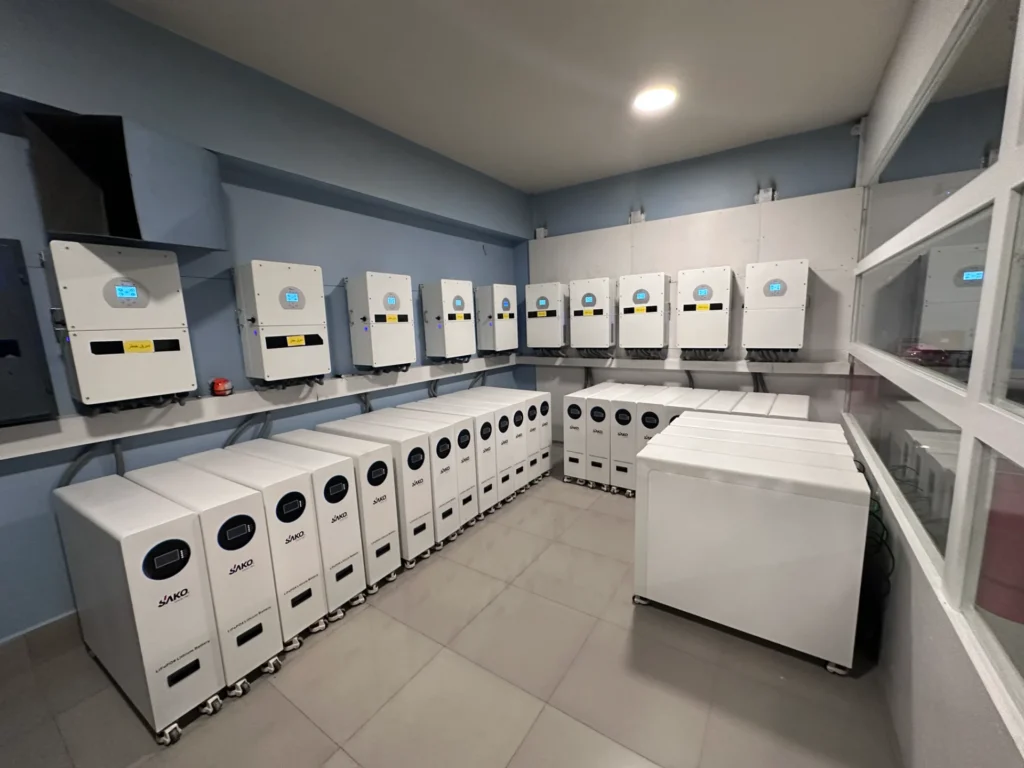
From a real estate perspective, this means luxury homes can accommodate grander energy systems without awkward retrofits. A villa with three-phase power can seamlessly house a 20+ kW solar array and a large-scale battery, or multiple 22 kW EV chargers, without hitting the limits of its service. By contrast, single-phase homes often find themselves maxed out. For example, a single-phase 63-amp, 230-volt supply can only deliver about 14 kW total in a worst-case scenario. Such a house would need costly utility upgrades or parallel meters to match the same power. In effect, three-phase infrastructure becomes a “license to upscale”—just as skyscrapers require multi-phase transformers, luxury homes need a multi-phase feed to support their growing loads.
This future-proofing has tangible market value. High-net-worth buyers often view electrical infrastructure as a risk-based checklist: Will the home sustain tomorrow’s AC, EV, automation, and renewables? On-site generation and storage are now mainstream in prime Middle Eastern projects, and three-phase wiring is the silent enabler behind them. For instance, the UAE’s push for energy efficiency and rooftop solar in Sheikh Zayed residences implicitly demands three-phase distribution to handle large inverter outputs. In Kenya and Nigeria, expatriate and local elites building gated compounds are likewise specifying three-phase to ensure even, high-capacity service. In sum, a home built or rewired for three-phase power carries a “premium readiness” badge—one that speaks to longevity, lower risk, and higher resale appeal.
Critically, three-phase infrastructure also positions properties at the leading edge of the energy transition. With three-phase busbars, adding a multi-kilowatt solar PV array or a modular battery system is straightforward, as many commercial inverters and hybrid systems are designed for three-phase outputs. Similarly, microgrid designs in Africa—which combine PV, diesel gensets, and storage—almost universally rely on three-phase networks to balance generation and loads. A decentralized three-phase microgrid can “island” seamlessly during grid outages while serving heavy loads evenly. In practical terms, a three-phase-equipped home can deploy a full-featured hybrid system (solar, battery storage, and optional backup generators) far more easily because the main panel already has separate phases to tie each component into, along with inherent load-balancing to optimize performance.
Finally, we note differentiators between regions. In the GCC, where daytime humidity and heat drive enormous cooling loads, three-phase power ensures that even peak-demand villas never droop under sagging voltage. It also prepares homes for the region’s growing EV fleets and smart grid pilots. In African markets, three-phase readiness mitigates chronic reliability issues: well-designed three-phase home systems with local storage can bridge frequent national-grid blackouts, offering higher Tier-1 reliability to owners. Cities like Nairobi and Lagos see luxury estates install dedicated substations (providing a three-phase 11–33 kV supply) precisely to guarantee upscale power. Whether via a utility microgrid or a private hybrid system, having a three-phase backbone means a house can enjoy utility-level resilience and the real estate premium that entails.
In short, three-phase capability should be viewed not as an optional cost, but as an investment in the property’s asset quality. It broadens the home’s technical mortgage—its ability to handle new systems—and visibly attests to its modernity. Just as an elevator or a smart-control package elevates a building’s market positioning, so too does a three-phase distribution system. The evidence from East Africa is clear: new substations in developing suburbs often underpin double-digit returns in land values. In high-end enclaves, being “power-strong” is a competitive edge, and three-phase is the infrastructure that delivers it.
Unlocking Superior Performance: Appliance & Lifestyle Optimization
Beyond long-term value, three-phase power delivers immediate, tangible performance gains for home systems and inhabitants. In luxury homes—where air conditioning units, kitchen appliances, pools, lifts, and EVs all run nearly continuously—three-phase wiring ensures each can run at peak design efficiency without compromise. We outline a few key dimensions:
- HVAC and Cooling Systems: High-end tropical villas often rely on multi-ton chillers or central heat-pump systems, which themselves use three-phase motors. Such motors are inherently more efficient and smoother-running than single-phase equivalents. Industry data shows that a comparable three-phase induction motor typically operates at 85–95% efficiency, whereas a single-phase motor of the same size is only 70–85% efficient. In practice, this means up to 10–15% better electrical-to-mechanical conversion for compressors and fans. Under Gulf summer conditions where the ambient temperature exceeds 40°C, every percentage of efficiency yields significant energy savings. For example, if a single-phase-driven AC system draws 10 kW to produce a certain amount of cooling, a three-phase unit might only draw approximately 9 kW for the same output, assuming a similar design. Over the lifetime of a large HVAC plant, those savings accumulate. There is also an operational smoothness benefit: three-phase compressors produce constant torque, which never falls to zero as a single-phase motor’s power sinusoid does, reducing vibration and maintenance issues. In short, the Coefficient of Performance (COP) ratios of whole-building cooling systems improve with three-phase power because their motors run cleaner and start easier—factors tough to quantify but recognized by HVAC engineers. One manufacturer notes that three-phase setups ensure stable voltage and reliable performance for high-power equipment, which is exactly the case when many large AC units start simultaneously.
- Electric Vehicle Charging: High-end homeowners are at the vanguard of EV adoption. Three-phase homes can support the fastest available AC charging speeds. A standard single-phase 32-amp circuit can deliver about 7.4 kW, calculated as 230 volts multiplied by 32 amps, whereas a three-phase 32-amp circuit at 400 volts can push 22 kW. That is literally a threefold speed-up: an EV that takes 10 hours to charge on single-phase could charge in approximately 3–4 hours on three-phase.
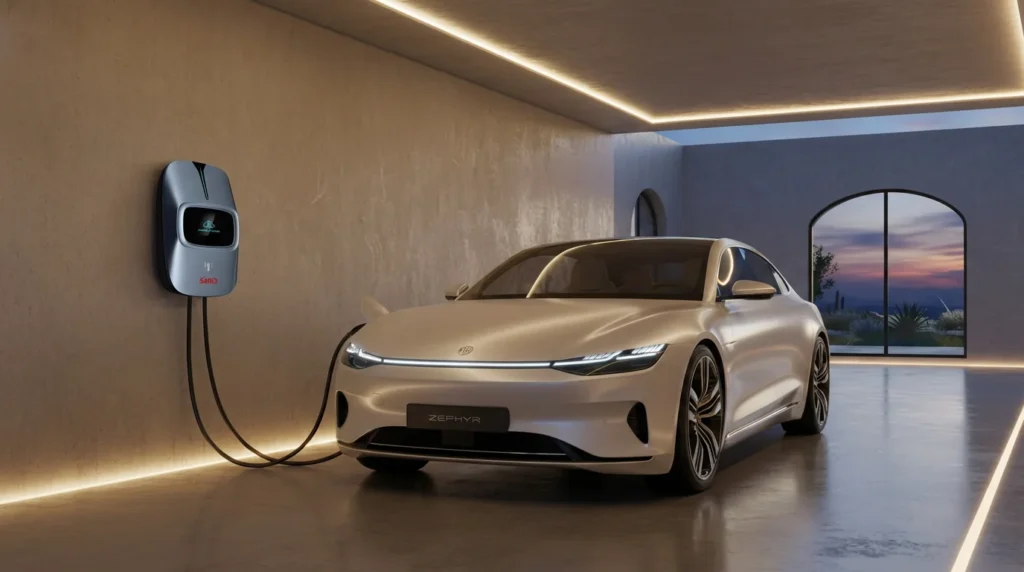
Notably, for households with multiple EVs—a growing trend among affluent families—the faster three-phase chargers allow simultaneous or rapid back-to-back charging, which is crucial to avoid schedule clashes. Moreover, advanced Vehicle-to-Grid (V2G) or Vehicle-to-Home systems demand high power throughput for both charging and discharging. Under V2G, an EV can function as a distributed battery. But to export power at a significant rate, the system must support 11–22 kW in both directions, which is only feasible on a three-phase supply. Technical reviews note that single-phase EV charging is capped at around 2–8 kW, whereas a three-phase interface can deliver approximately 19.2 kW at 80 amps or even up to 22–32 kW. In practice, this means that if a luxury homeowner in the Gulf wants to implement a full-featured V2G strategy, such as discharging a Tesla or Porsche to power the home at night, a three-phase charger is essentially the only way to realize it. Without it, the car is limited to low-power modes that waste its large battery potential.
- General Heavy Loads: Besides AC and EVs, luxury residences often have other substantial electrical appliances: commercial kitchen equipment, elevators, pool pumps, saunas, and EV lifts or garages. Many of these are motor-driven or inductive loads that naturally favor three-phase power. For instance, pool filtration systems commonly use three-phase motors for efficiency and durability. A three-phase pump can have higher starting torque and run with less current overall than a single-phase version, lowering resistive losses, which are calculated as the current squared multiplied by the resistance. Indeed, pumping industry guides highlight that three-phase pump motors are more compact and energy-efficient than their single-phase counterparts for the same horsepower rating. In effect, paying a bit more to wire for three-phase enables the use of more efficient machinery, such as commercial-grade compressors with shorter duty cycles, which then reflects in smoother appliance operation and lower operational energy per function. The principle is general: three-phase allows higher power appliances to function optimally.
- Power Quality and Balance: When a home draws power across all three phases, the net neutral current is minimized—ideally zero if perfectly balanced. This makes for cleaner power: voltage on each phase remains steadier under load, and the opportunities for harmonic distortion and voltage flicker drop significantly. As a concrete effect, sensitive electronics, from server rooms to audio-visual systems, enjoy better protection. In a single-phase house with heavy alternating loads, the shared neutral can carry large currents and cause the voltage on phase wires to sag, leading to flickering lights or small brownouts. Conversely, three-phase distribution distributes load more evenly than single-phase, helping prevent voltage drops and system overloads. Practically speaking, this means a modern smart home streaming 4K video, a home theater, or a medical-grade air filter can run without nuisance voltage sags even when AC compressors cycle on.
- Extreme-Condition Performance: In the Gulf’s blazing sun or Africa’s tropical heat, the grid supply can already be strained. Three-phase homes are better insulated against such extremities. Consider that air conditioners draw more amperage at higher ambient temperatures to maintain setpoints. On a single-phase supply, this can disproportionately load one line. On three-phase, each AC unit or circuit can be assigned to its own phase, capping the draw at approximately one-third per conductor. If one phase does dip, perhaps due to a neighbor’s load spike, the home still has two other phases supporting the bulk of its needs. This inherent redundancy enhances resilience during peak demand hours. Additionally, on a utility with some harmonic distortion, which is common in mixed rural/urban grids, the symmetric sinusoidal nature of three-phase currents cancels out certain harmonics, which in turn protects both supply quality and equipment life.
In sum, the lifestyle dividends of three-phase power in a luxury home are substantial. Homeowners immediately enjoy faster EV charging, more quiet and efficient climate control, and a lower risk of brownouts or flicker. These advantages become even more pronounced when combined: for example, simultaneous 22 kW EV charging and full-speed air-conditioning become feasible only on three-phase. Without such a supply, a high-end home might have to stagger operations or undercut device ratings. With it, the entire suite of modern living technologies works in concert as intended.
We present the core of that rationale:
- Upfront CAPEX – Wiring and Panels: Three-phase service requires one extra hot conductor and often a larger meter or panel compared to single-phase. This does incur higher initial material and labor costs. Rough industry figures suggest that a quality three-phase panelboard can cost on the order of $800–$1,200 for a 200 A unit, versus $350–$600 for the single-phase equivalent. Similarly, the installation often takes slightly longer due to additional cable runs and balancing. However, the power density advantage quickly offsets this. As noted earlier, three-phase can deliver a power increase equivalent to the square root of 3 (approximately 1.732) times that of single-phase on the same wire gauge. Put differently, to serve heavy loads of approximately 50 kW total demand, a single-phase system would need much heavier conductors—possibly three times the copper—and multiple parallel runs. Those oversized conductors cost far more than the fourth wire of a three-phase system. A detailed panelboard guide notes: The 1.732 advantage means smaller, cheaper conductors: delivering 18 kW on single-phase at 240 V requires 75 A (and hence #4 AWG), whereas with three-phase we can use #6 AWG at 50 A. By buying the three-phase panel once, the homeowner avoids repeatedly upsizing circuits for each new large load.
- Distributed Loads and Phase Balancing: In practice, three-phase designs balance circuits. In a large house, one might put lighting and small loads on Phase A, heavy air-conditioning on Phase B, and EV charging on Phase C. This spreads the current evenly across the feeder wires. By contrast, a single-phase build forces heavy loads to share the same two wires and the neutral, driving up their combined currents. Higher currents mean more resistive losses, which are calculated as the current squared multiplied by the resistance. In fact, simulations of distribution networks show that for most practical load imbalances, a three-phase arrangement consistently yields lower line losses than the analogous single-phase scenario. Only in the rather unrealistic case of very extreme phase imbalance would single-phase come out ahead. As one engineering analysis concludes: For most distribution networks, three-phase networks will usually be more efficient at reducing resistive losses than single-phase networks. This is largely because in a three-phase system, the neutral carries only the unbalanced current, which is typically small, whereas in a single-phase system, the neutral carries the entire return current. Less current in each conductor translates directly to lower resistive losses over time, lowering operating costs.
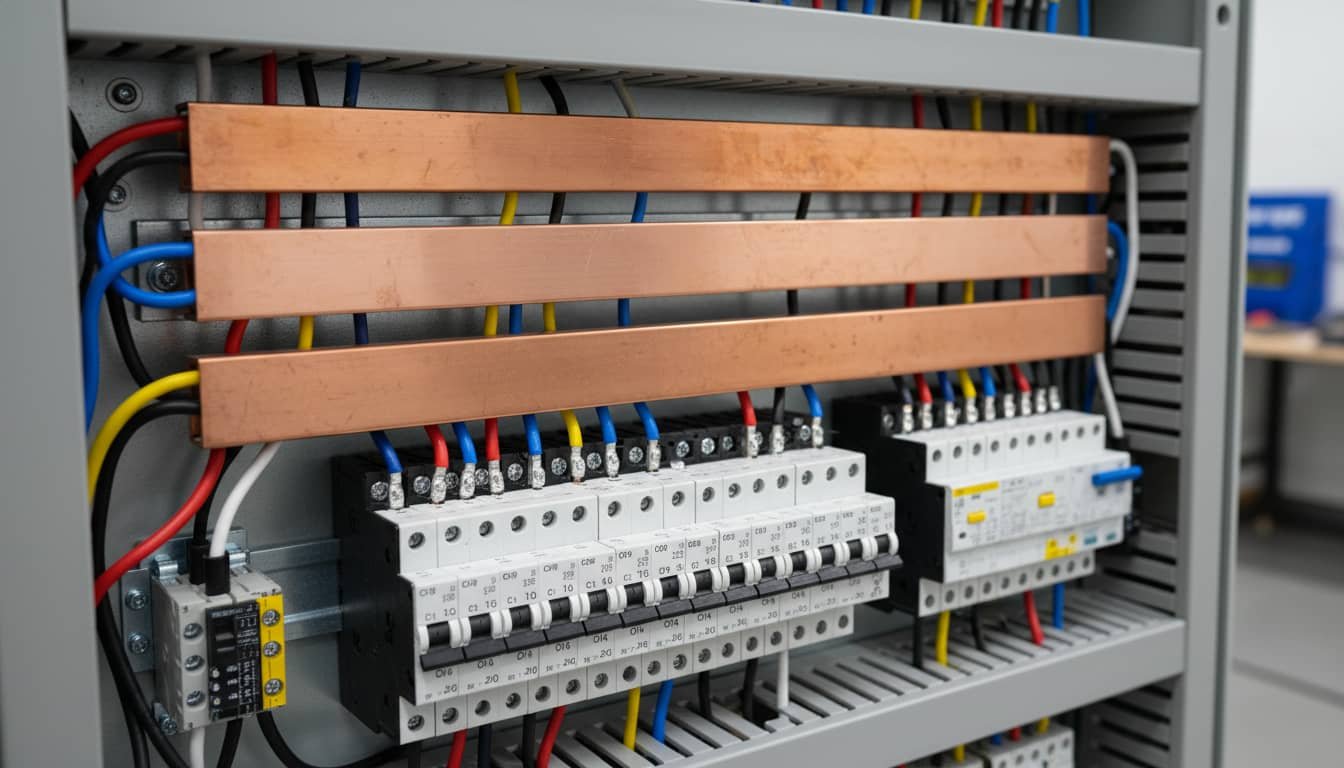
- Energy Efficiency & OPEX Savings: The reduced losses and higher motor efficiencies accrue to real savings. For example, a study of a typical 75 HP (approximately 56 kW) motor load showed that a three-phase supply could save thousands of dollars per year relative to single-phase power when factoring in energy costs. One panelboard guide summarizes a lifecycle case: spending an extra $800 on a three-phase panel prevented at least $12,000–$15,000 in downstream equipment failures and losses over two decades. Translating to homes, similar logic applies: smaller motors, shorter run-times, and balanced loading all cut the monthly bills. Even modest percentage improvements add up at luxury power scales. Furthermore, the power factor tends to improve under three-phase power, as balanced capacitive and inductive loads can be neutralized per phase, which can help avoid utility penalties in jurisdictions with demand charges.
- Reduced Voltage Drop: Over the distances of home wiring, which are often tens of meters, the voltage drop under load can become consequential. With three-phase, each phase wire carries only a fraction of the total power, so the voltage drop per wire is lower. This means the end-point voltage at each outlet or device remains closer to nominal, improving device performance and protecting electronics. In a single-phase house drawing, say, 40 kW for air-conditioning and pool pumps, the feeder wires might see over 100 A, and a drop of several volts could occur. Splitting that draw into three 33 A phases cuts the drop by roughly two-thirds, plus the system’s power delivery never hits zero crossings. Architects note that in premium homes with large plots, the runs to outbuildings like garages or pool areas can be long; here again, three-phase wiring keeps those structures properly powered without requiring excessively thick feeder cables.
- Lifecycle and Reliability Benefits: Three-phase installations, when done correctly, inherently improve system reliability. For one, with three distinct phases, a fault or overload on one phase generally does not darken the entire house—only that branch trips. Many modern panel designs incorporate selective three-phase breakers and monitoring so that single-phase faults are localized. Also, because the burden on any single conductor is reduced, the overheating and aging of wires and neutrals are mitigated, lowering fire risk and maintenance needs. Some industry sources tout exemplary ROI: Over 20 years, a three-phase panel yields 15:1 to 20:1 returns on investment through reduced downtime and equipment preservation. While the homeowner might save “only” a few hundred dollars on the panel up-front, they avoid thousands later on repairs or replacements of major appliances that would otherwise be stressed or desynchronized.
- Tariff Structures and Billing: In regions where residential rates differ from commercial rates, appropriate utility contracting is needed. In many African countries, purely residential (single-phase) customers pay subsidized or lower flat tariffs, whereas a three-phase supply, even in a home, may be billed at a different tier. High-end developments often negotiate special tariffs or are wired as “residential/commercial hybrid” to avoid punitive rates. Importantly, several East African utilities are introducing time-of-use pricing or demand charges for heavy consumers. A home with three-phase power and on-site storage or solar can optimize wealth—for example, by using batteries to shave peak demand or switching to solar during high-price slots—a flexibility that single-phase homes rarely realize. In sum, while in rare cases a grossly land-scaled villa might face a higher meter charge on three-phase, the overwhelming evidence is that an inclusive design assuming high load yields net savings.
Combined Case Study: A Dubai Luxury Villa
Consider a hypothetical ultra-luxury villa on the outskirts of Dubai. The owner plans a multi-story, 10-bedroom mansion of over 10,000 sq. ft. with extensive amenities: 10-ton central chiller troughs, multiple sub-AC units, an infinity pool with heating and fountains, a home theater, and provisions for three electric vehicles. They also wish to install a 30 kW rooftop solar array and a 30 kWh battery system for night backup and peak shaving.
In this scenario, a three-phase supply is effectively mandatory. Three-phase breakers will run the chillers and pumps more smoothly, achieving higher kilowatt-per-ampere throughput. The three EVs can each have 22 kW chargers for a simultaneous 66 kW draw, enabling truly fast home charging; with single-phase, the options would be limited to approximately 7 kW each, forcing overnight waits or sequential charging delays. The 30 kW solar inverter will itself likely be a three-phase unit, as common commercial inverters produce power in three-phase 400 V, so the house panel must accept three-phase AC input from the PV system.
Running everything concurrently—for instance, near mid-day when ACs are running and solar generation is at its peak—the house might draw an instantaneous load of over 100 kW. On a single-phase 240 V supply, that would require over 400 A, which is utterly unfeasible for a home panel. With a three-phase 400 V supply, the load is only approximately 145 A per phase—still high, but within the realm of a custom utility transformer or local substation feeding the estate.

From the homeowner’s cost perspective, the extra wiring for three-phase is modest against the villa’s budget, with the differential being a few percent of the total build-out versus the tens of millions of AED in property value. Yet the benefit is clear: the owner gets full utilization of every system. During a power cut, the villa’s microgrid can operate in island mode on battery and emergency generator power. The three-phase architecture ensures that each inverter or generator phase feeds a balanced part of the load, preventing the overloading of a single inverter module or causing trip events. Over years of operation, the energy savings from more efficient HVAC and lower losses will sum to tens of thousands of dirhams, especially given Dubai’s higher electricity tariff for large consumers. In sum, installing three-phase power at the outset converts the villa into the maximum-utility luxury home it was designed to be, rather than a constrained compromise.
At a foundational level, three-phase power underpins several key technical advantages that protect system integrity and lower total lifetime cost. These advantages can be summarized as follows:
- Inherent Load Balancing: By design, three-phase circuits naturally share currents. A mathematically balanced three-phase system has zero neutral current, and each phase carries only one-third of the total power for evenly distributed loads. This dramatically reduces resistive losses, which are calculated as current squared multiplied by resistance, on any single conductor. In contrast, any unbalanced single-phase load sends all its current through the neutral return. As one analysis shows: Unless the load imbalance is extreme (more than a 3-to-1 skew), a three-phase distribution will always have less line loss than a comparable single-phase system. In practical terms, everyday household fluctuations, such as one AC being on while another is off, seldom approach such imbalances. Therefore, the homeowner almost always enjoys lower resistive waste with three-phase power.
- Neutral Conductor Economy: In three-phase installations, the neutral wire carries only the vector sum of the three phase currents, which often nearly cancels out. This means the neutral conductor can be the same gauge as the phase wires or even smaller. By contrast, in a single-phase home, the neutral must often be the same heavy gauge as the hot wire because it carries the full return current. This difference not only saves copper but also simplifies safety, as the neutral in a three-phase system does not get as hot over time. In short, the wiring is inherently “lighter” for the same power throughput.
- Voltage Drop and Power Quality: Heavy loads on any electrical network cause voltage drops along the wires. Three-phase power alleviates this by splitting the current across three paths. Where a single-phase feeder of 50 A over 30 meters might drop several volts, the equivalent three-phase feeder with approximately 17 A per line often sees a drop of a few volts or less. Higher voltage at the equipment means higher motor torque and reduced current draw, since motors draw proportionally less current at their nominal voltage, which loops back to efficiency gains. It also means less flicker and lower harmonic distortion—particularly important for high-end electronics and appliances that can be disturbed by even small voltage sags.
- System Lifespan and Reliability: By avoiding extreme currents in any one conductor or device, three-phase systems tend to outlast single-phase setups. The reduced thermal stress on breakers, cables, transformers, and panel components delays insulation breakdown and loosens fewer connections over time. Many commercial maintenance records, such as those for small data centers, show dramatically lower failure rates once three-phase power was used instead of single-phase for large loads. Analogously, in a luxury home’s multi-phase panel, each circuit operates closer to its design limit instead of a few circuits being perpetually maxed out. This lowers the risk of nuisance trips or feeder failures.
- Transformer and Utility Interaction: If the property is supplied via a local transformer, a three-phase load flow means the transformer is used more uniformly, stabilizing its temperature. If the home uses its own backup generator(s), employing a three-phase generator or generator set allows for full rated output versus being handicapped into single-phase mode. Three-phase generators and inverters are also typically cheaper per kVA to purchase than multiple single-phase units of equal capacity due to the physics of three-phase winding. Thus, on-site power sources—which are very common in Gulf homes for resilience—benefit from the economies of scale of three-phase machines.
- Tariff and Billing Implications: In many African and Middle Eastern markets, large residential consumers may eventually face kVA demand charges similar to commercial customers, or special meter tariffs for three-phase service. A well-balanced three-phase home can mitigate apparent demand peaks by distributing loads and can pair with smart metering to exploit off-peak rates. Additionally, some utilities even offer small incentives or lower rates for customers who operate near unity power factor; since three-phase systems allow easier installation of phase-balancing capacitors or advanced inverter correction, homeowners can sometimes secure those benefits more readily. While exact tariff structures vary by country and utility, the flexibility of a three-phase setup generally only adds options, such as the ability to contract as a light industrial user if favorable, compared to a fixed residential single-phase contract.
A Nairobi High-End Community (Case Study)
As a complementary illustration, consider an emerging upscale housing development on Nairobi’s outskirts. This planned community includes dozens of high-end residences, each designed with the integration of solar microgrids and EV chargers in mind. The developer equips the neighborhood with a mini substation and distributes a three-phase 415 V supply to every plot, rather than the usual single-phase village circuit. Each villa is connected so that inverters for solar and storage and smart-energy systems can tie into all three phases.
On the homeowner side, three-phase wiring inside makes a true hybrid microgrid possible. For example, each house might have an 8 kW three-phase solar inverter plus a 10 kWh battery, with a 22 kW EV charger and multi-ton air conditioners.
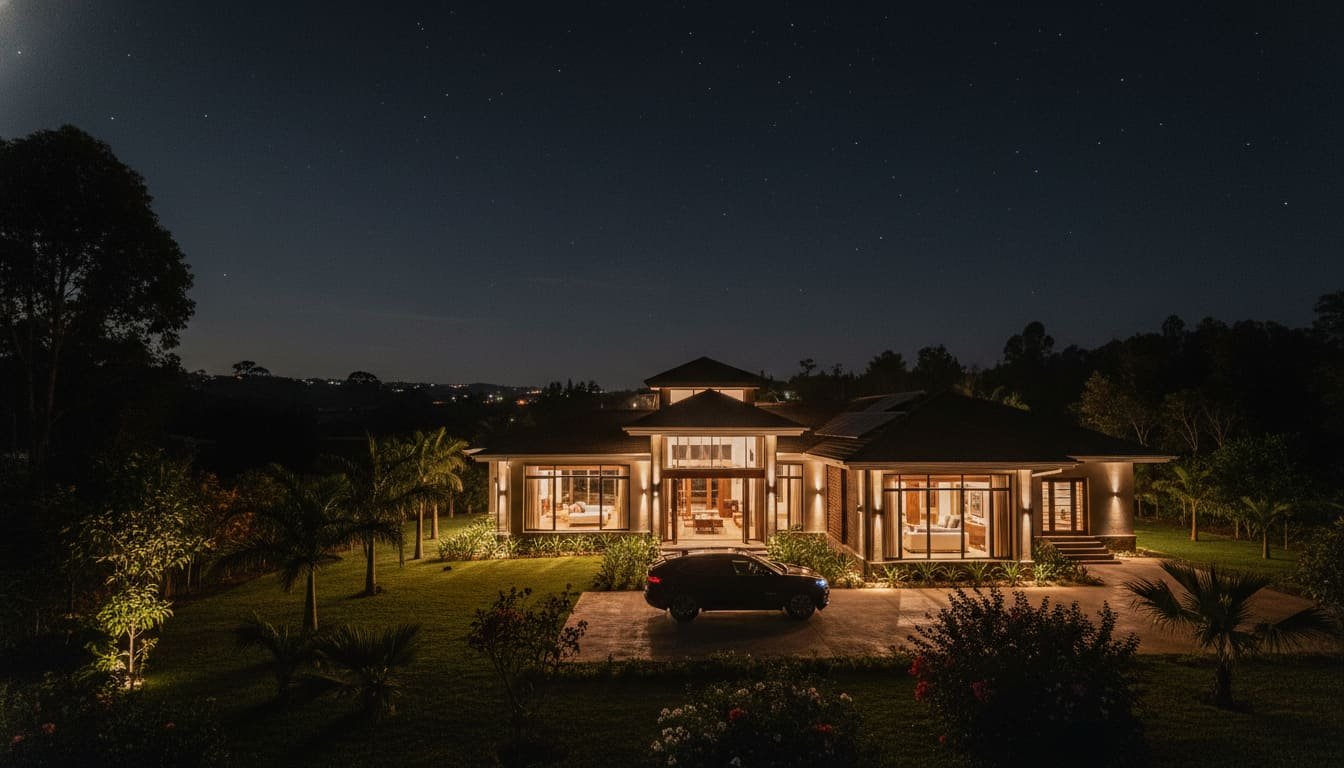
During occasional grid outages, which are still common in Kenya, these homes run off the battery and lease diesel backup seamlessly. The dense phase wiring means that even if one inverter or generator fails, the remaining phases can pick up some of the load until repairs are made. Over months of dry season operation, these homes dramatically cut diesel spending by maximizing solar output. By contrast, a neighboring middle-class area on single-phase power struggles to integrate even a 5 kW inverter without tripping.
This Nairobi example underscores a key point: resilience through three-phase. Houses that might otherwise need separate mini-generators for cooling can instead rely on the same solar and storage grid that a light-commercial site would use. It also highlights the impact on land value: plots in this new estate command a premium precisely because the electrical network is “investment-grade.” As the Kenyan experience shows, incoming high-net-worth buyers often specifically ask, “Can the house run 24/7 with its own power if needed?” The developer’s answer, backed by three-phase integration, is yes. The premium commanded, often a 10–20% add-on to the list price, is partly justified by this assurance of self-sufficiency and high-end infrastructure.
Conclusion
Three-phase electrical infrastructure is not merely an incremental improvement but a fundamental enabler for today’s luxury residences. Our analysis shows that three-phase power multiplies a home’s capability: it raises its power throughput √3-fold for a given cable, cuts operating losses, elevates motor efficiency, and supports high-speed EV charging and large renewables systems. For homeowners and developers in the Middle East and Africa—regions where extreme climates meet a surge in high-tech lifestyles—these benefits directly translate to cost savings, comfort, and market differentiation. In high-end markets, forward-thinking designers and buyers already treat robust power infrastructure as part of the “amenities suite.”
Quantitatively, the economics favor three-phase: minor additional capital expenditure on panels and cabling is paid back many times over via energy savings, avoided upgrades, and peace of mind. Technically, the power quality improvements, such as reduced neutral currents and stable voltages, safeguard expensive electronics and reduce maintenance. Conceptually, homes built on three-phase grids are ready to become microgrid hubs, supporting their own generation, storage, and even serving neighbors in island mode during outages.
In light of these findings, high-end homeowners, architects, and engineers should regard three-phase supply as a baseline standard, not an optional extra. Planning for it early, ideally at the building permit stage, is far cheaper than trying to retrofit later. As one UAE installer noted, once you realize the lifestyle uplift—from blazing-fast EV fills to whisper-quiet air conditioning—it is clear: “Why settle for one phase when the other two await?”.
Recommendation: For luxury residential projects in the Middle East and Africa, embed three-phase panels in every villa or apartment, even if initial loads seem moderate. Ensure utility service agreements account for the higher-rated service. Specify appliances such as EV chargers, inverters, and motors to leverage the available phases fully. In doing so, the property will command higher value today and be fully prepared for the next decade’s technology trends—truly making three-phase power an investment rather than a cost.