Part 1: The Energy Challenge
Across emerging markets, homeowners face a common frustration: unreliable power and high tariffs. In many African and Asian countries, aging grids collapse frequently and impose erratic supply. For example, Nigeria – with Africa’s largest population – suffers repeated grid collapses that cost the economy an estimated $29 billion per year. South Africa experienced years of rolling “load-shedding” (planned blackouts) until briefly halted, only to announce new Stage 3 outages after just ten months of stability. In Asia, countries like Pakistan have seen surging electricity tariffs under economic reforms, driving solar adoption – Pakistan’s solar share jumped from 4% to 14% of supply by 2024.
Tariff hikes are spreading. For instance, Nigeria raised high-use tariffs from ₦68 to ₦225 per kilowatt-hour in 2024, and Egypt enacted cuts to electricity subsidies, raising household rates by 14–50%. These reforms pass costs onto consumers, making power bills a sore point for middle-income families, often in environments with inflation over 30%. Between frequent outages and volatile prices, households increasingly seek energy independence. Rooftop solar is booming, but without storage, many people can only use sunshine while it’s shining. Batteries promise not just backup during blackouts but also savings by shifting load away from peak-price hours.
Key pain points:
- Grid instability: This includes frequent blackouts, exemplified by the estimated $29 billion annual economic loss in Nigeria and recurring outages in South Africa.
- Soaring tariffs: Driven by subsidy reforms in countries like Nigeria and Egypt, alongside inflationary pressures in places like Pakistan.
- Desire for self-sufficiency: Homeowners want to avoid the erratic grid and reduce high electricity bills.

Part 2: Persona-Driven Decision Matrix
No single system fits all needs. We will analyze All-in-One versus Split (separate inverter and battery) architectures through three homeowner personas:
- Design-Conscious Homeowner: Cares about aesthetics, simplicity, and having a single vendor for support.
- Pragmatic Investor: Prioritizes lowest total cost of ownership (TCO), highest return on investment (ROI), and proven long-term performance.
- Tech-Savvy Prosumer: Wants maximal customization, system control, and the flexibility to upgrade individual components (like the battery or inverter) over time.
The table below compares how each system addresses the top priorities of each persona:
| Persona | Priority | All-in-One System | Split System (Separate Units) |
|---|---|---|---|
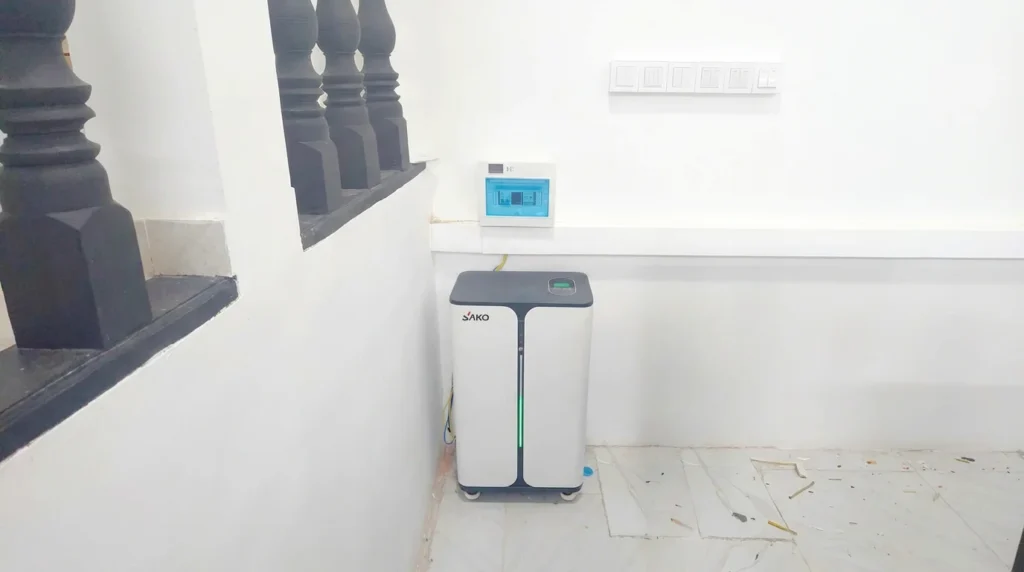
| Design-Conscious Homeowner | Sleek Aesthetics & UX | Single integrated unit; clean installation with one enclosure (e.g., Tesla Powerwall’s “sleek cuboid” design). Fewer visible wires or boxes (tidier wall appearance). | Requires two or more separate enclosures (battery box + inverter), which can look cluttered on a wall or in a garage. Matching styles is hard. |
| Ease of Installation & Use | Plug-and-play by design: components are pre-matched. Install is faster (one unit, fewer cables). The vendor’s app/UI controls everything together. | Installation is more complex (battery, inverter, additional wiring and connectors). Often requires ensuring compatible communications; more DIY or installer time needed. | |
| Single-Vendor Support | One warranty and support contact for the whole system – no finger-pointing between companies. Updates and service are unified. | Two or more vendors (battery maker and inverter maker). Split responsibility can complicate service/support calls and patching firmware. | |
| Pragmatic Investor | Low Upfront Cost & TCO | Tends to have higher engineering softness and brand premium. The integrated unit may cost more per kWh up front. However, installation labour can be slightly lower (simpler work). | Can shop for least-expensive components. A DIY installer might source a cheaper Chinese LiFePO₄ battery (around $50–60/kWh for cells, or around $400–500/kWh assembled) plus a generic inverter, often undercutting integrated brands. Labor costs are higher due to complexity, but hardware cost can be lower. |
| Efficiency & Savings | Usually DC-coupled: solar and battery share a DC bus. Round-trip efficiency is typically higher (around 90%) because energy avoids extra conversions. More of each solar kWh ends up stored or used. | Often AC-coupled, where power converts from DC to AC and back to DC. This results in a lower round-trip efficiency (around 85%), so more energy is lost in conversions. This slightly reduces bill savings. | |
| Reliability & Maintenance | Designed as a single unit where components are engineered to work together. Some all-in-one brands use LiFePO₄ cells rated for 100% depth-of-discharge. However, if any part fails (e.g., inverter electronics), the whole unit may go offline until serviced. Battery replacement may require buying a full new module from the manufacturer. | Components are modular. If the inverter fails, you can swap it without touching the battery, and vice versa. You can individually replace aging battery cells or the inverter, potentially lowering the life-cycle cost. Many consumer Li-ion batteries degrade over time, and modularity means you only need to replace what has worn out. |
From the above matrix:
- Design-Conscious: All-in-One systems clearly win on look and simplicity.
They deliver one tidy box and single-vendor ease, matching this persona’s desire for “frictionless” ownership. Split systems leave extra boxes on the wall and require juggling two brands, contrary to this persona’s preference.
- Pragmatic Investor: Total cost and efficiency matter most here. An All-in-One system may charge a premium; for instance, a 13.5 kWh Tesla Powerwall 2 unit retails at approximately R174,000 in South Africa, or roughly $9,000. In contrast, we can estimate a 10 kWh LiFePO₄ battery pack at around $6,000 (approximately $600/kWh) plus a $1,500 inverter. Even accounting for higher installation labor, the split system often yields a lower TCO. Additionally, while the efficiency edge of DC-coupling in an All-in-One system provides a slight financial benefit (approximately 5% more energy stored), the easier upgrades and component sourcing of a split setup tend to favor ROI-focused buyers over time.
- Tech-Savvy Prosumer: This persona values modularity and control. Split systems win hands-down, as a separate inverter and battery allow you to mix brands or swap technologies later. For example, they could start with a 5 kW inverter and add extra batteries or a different chemistry without replacing everything. Monitoring and control can often be customized with open protocols on modular inverters. All-in-One systems usually lock you into the vendor’s ecosystem and expansion path, requiring you to buy more of the same unit type. Therefore, tech-savvy users will lean toward the split architecture for its flexibility and upgradability.
The persona summaries clearly show that All-in-One systems score high on simplicity and integrated design, while Split systems score higher on cost-effectiveness, flexibility, and future-proofing. Both types can satisfy different priorities, but the choice depends on which factors matter most to the buyer.
Part 3: Investment Thesis & Final Verdict
Assumptions: To quantify the trade-offs, we model a representative 10 kWh home storage scenario with a 5 kW inverter capacity. Our baseline assumptions align with recent market data: battery modules at roughly $500–$600 per kWh (pack), a 5 kW inverter at approximately $1,500, and installation around $2,000–$2,500. For example, a 13.5 kWh Tesla Powerwall package was priced at around $9,000, implying about $7,000 for a 10 kWh all-in-one unit; we round this to $10,000 plus or minus installation in our model. For the split system, we assume a 10 kWh LiFePO₄ battery at about $6,000 plus a 5 kW hybrid inverter at around $1,500 plus installation, totaling $10,000 initial capital expenditure (CAPEX). We assume a 10-year battery life with a replacement at year 10 at the same pack cost of $6,000, and a modest 2–3% annual capacity fade.
Grid electricity is assumed to be $0.10/kWh (100 USD/MWh), a mid-range value considering local variations, where residential rates can be as low as $0.03 in Nigeria or reach approximately $0.20 in the Philippines. In summary, our base-case inputs are:
- All-in-One: A 10 kWh system priced at $10,000 plus a $2,000 installation cost equals a $12,000 capital expenditure (CAPEX). The round-trip efficiency is approximately 90%.
- Split System: A 10 kWh battery at $6,000, a 5 kW inverter at $1,500, and a $2,500 installation cost result in a $10,000 capital expenditure (CAPEX). The efficiency is approximately 85%, with a year-10 battery replacement cost of $6,000.
- Electricity Price: The base price is assumed to be $0.10/kWh, with a scenario including a 20% increase to $0.12/kWh.
10-Year TCO Calculation
The following table shows the 10-year cash flows. The calculation includes all capital expenditure and replacement costs, from which we subtract the value of avoided grid electricity. This value is determined by multiplying the battery’s total output by the electricity price. For clarity, a simple sum is used without applying discounting.
| Metric | All-in-One | Split System |
|---|---|---|
| Initial CAPEX (incl. install) | $12,000 | $10,000 |
| Battery replacement (Year 10) | $6,000 | $6,000 |
| Total 10-yr investment | $18,000 | $16,000 |
| 10-yr energy dispatched (net) | ||
| Equivalent energy value (base tariff) | –$3,000 | –$2,700 |
| Net 10-yr cost (at $0.10/kWh) | $15,000 | $13,300 |
| Equivalent energy value (+20% tariff) | –$3,600 | –$3,300 |
| Net 10-yr cost (+20% tariff) | $14,400 | $12,700 |
Energy dispatched assumes daily cycling. For the All-in-One system, this amounts to roughly 3,285 kWh per year (based on 10 kWh at 90% efficiency). For the Split system, it’s about 3,102 kWh per year (at 85% efficiency). After factoring in an approximate 2% annual capacity fade over ten years, the total net dispatched energy is about 30,000 kWh and 27,150 kWh, respectively. At $0.10/kWh, this offsets approximately $3,000 and $2,700 in grid power costs.
Results
In our model, the Split system yields a lower net cost over 10 years. At a base tariff of $0.10/kWh, the All-in-One option has a net cost of approximately $15,000, while the split approach costs around $13,300. This makes the split architecture about 10% cheaper in terms of net total cost of ownership. When electricity prices rise by 20%, both systems provide greater savings, but the split system maintains its cost advantage with a net cost of approximately $12,700 compared to $14,400. In short, higher tariffs magnify the value of the battery, benefiting whichever system is chosen, but the relative cost gap between them remains.
These numbers hinge on our assumptions, but they illustrate a key point: All-in-One systems typically carry a price premium, which can offset their efficiency gains. Industry sources note that battery prices are continuously falling, with LFP cells dropping to $50–$60/kWh and pack costs plunging by approximately 58% in two years. Consequently, future capital expenditure may shrink. Nevertheless, even with cheaper batteries, the modular advantage of split systems often allows investors to optimize component choices, such as pairing a lower-cost foreign inverter with a battery.
Quality and Safety
Regardless of the architecture, buyers must insist on certified components. Reputable systems use batteries that meet IEC 62619 (safety for stationary Li-ion batteries) and IEC 62133 (cell and battery safety) standards. For example, TÜV-certified LiFePO₄ packs undergo rigorous tests, including short-circuit, overcharge, and thermal stress evaluations, as required by the IEC 62619 standard.
All-in-one vendors typically bundle tested batteries and inverters under a single safety certification, whereas components in a split system should each carry their own. Ultimately, the performance and safety of either system depend on choosing equipment that complies with these international standards.
Final Verdict
The “best” choice depends on your profile:
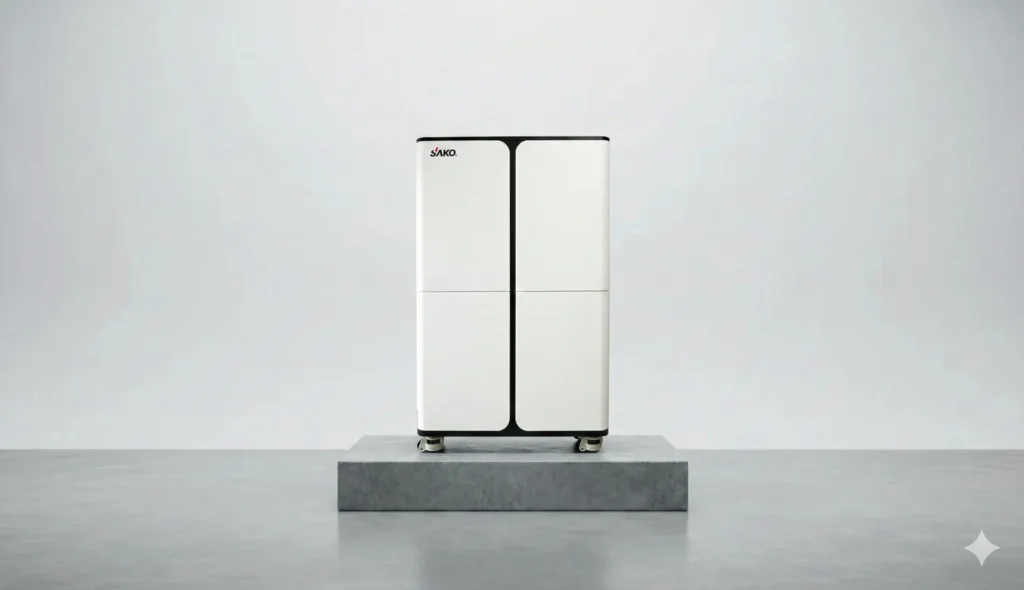
- Design-Conscious: You will appreciate the elegance and simplicity of an all-in-one system. Its unified design, such as a wall-mounted cuboid, and single-brand warranty are compelling. With a high efficiency of roughly 90%, you can store nearly all available solar energy. You may pay a premium per kWh, but for you, the seamless user experience is worth the cost.
- Pragmatic Investor: You will likely favor a split system for its cost efficiency, as our model shows a lower 10-year cost. You can purchase the battery and inverter separately, potentially choosing cost-competitive components, and replace only what ages. If return on investment is your primary driver, the small performance edge of an all-in-one system is often outweighed by its higher price.
- Tech-Savvy Prosumer: You will almost certainly prefer a split system. The flexibility to mix components, use open-source monitoring, and upgrade individual parts is a key benefit. An all-in-one system locks you into a single ecosystem, whereas a split system provides freedom, allowing you to, for example, add second-life EV batteries from any source to an existing inverter.

In conclusion, there is no one-size-fits-all winner. All-in-one systems shine when ease-of-use and aesthetics are paramount, while split systems excel when minimizing cost and maximizing options are the main goals. The total cost of ownership model shows that a split system often pays for itself slightly faster, especially as energy prices rise. However, if a design-conscious homeowner is willing to pay a premium for a sleek, integrated unit, that is also a valid choice. Whatever the decision, ensure the equipment meets international safety norms, such as IEC 62619 for batteries. In practice, many consumers find that modular (split) setups offer more optionality, while all-in-one setups provide premium convenience. The right pick helps avoid both blackouts and overspending.